







My friend Bridget and I have been talking about the weird cats of Aria.
“This woman cannot draw cats.”
“Look, I don’t disagree. There’s something very fucky about the way she draws cats.”
Maybe it’s a strange hang-up to have while watching an anime. Mascot characters are par for the course, and sometimes it’s impossible to even determine which species they are. I mean, what are Totoro’s little forest buddies, actually? And people say Totoro is a tanuki, but my guys, that is not what a tanuki looks like. Do we love him any less? Hell no. And then there’s Kyubey of Madoka Magica, who reveals itself not to be a cute cuddly rabbit-thing, but a soul-sucking alien whose placid face belies its apathy toward mankind.
Back to the fucky cats of Aria: The Animation. Cats are already perfectly designed for being lovable plush toys that can be fed to the public. They need no redesign, even though a little signature creativity doesn’t hurt. Hello Kitty has never needed a mouth, and her nose is usually yellow. Jiji (of Kiki’s Delivery Service) is the quintessential dream familiar for a burgeoning witch. Sailor Moon‘s Artemis and Luna? Those are cats with moons on their heads, and maybe some mascara, but inarguably still cats. Nyanko-sensei of Natsume Yuujinchou is a ball of mochi with a pompom for a tail—and also transforms into a flying yokai wolf god, but damnit, he is still entirely cat-coded. Recently, Turbo-Baba of Dandadan is trapped in the form of a lucky cat statue, cartoonish as hell, but CAT.
But just look at this abomination:
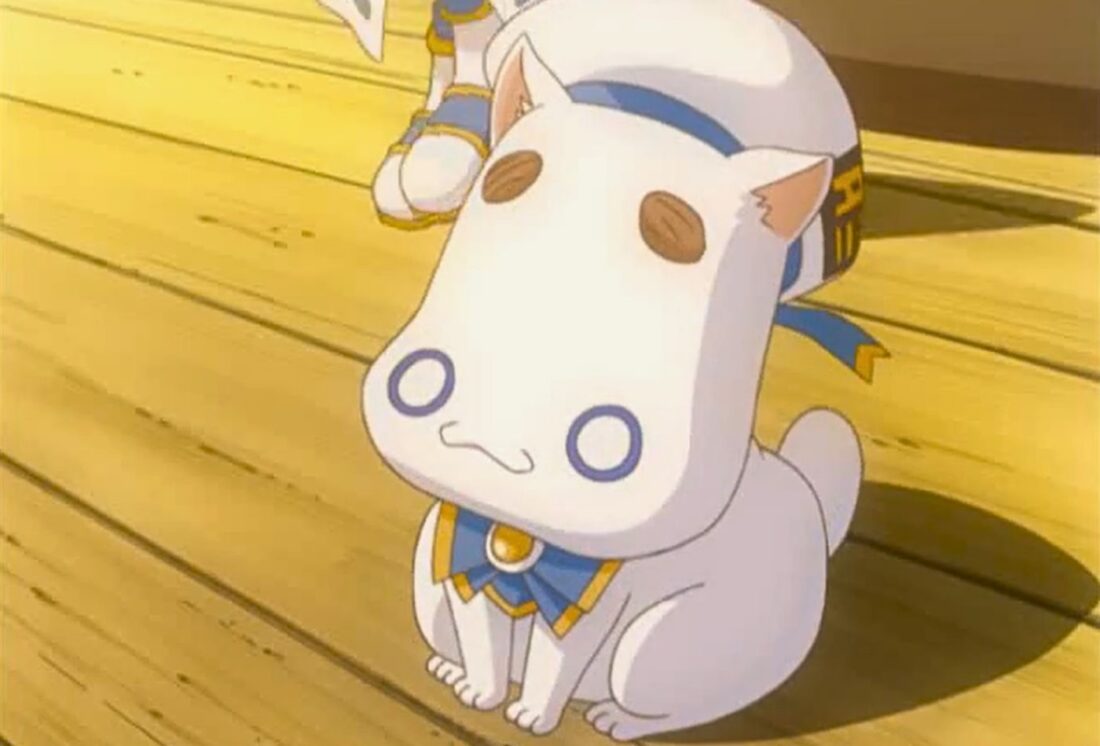
I have been devouring this classic slice-of-life science fiction anime about Venice being recreated on Mars and should probably stop fixating on the fact that this darned cat, the eponymous Aria of Aria: The Animation, looks more like the Michelin Man than any feline I know. It bothers me, but not enough to distract from the fact that this show—which is Bridget’s favorite series of all time, a show she has told everyone she knows and loves to watch for years, like preaching the gospel—is a genuine work of great optimism and beauty.
Welcome to Neo-Venezia
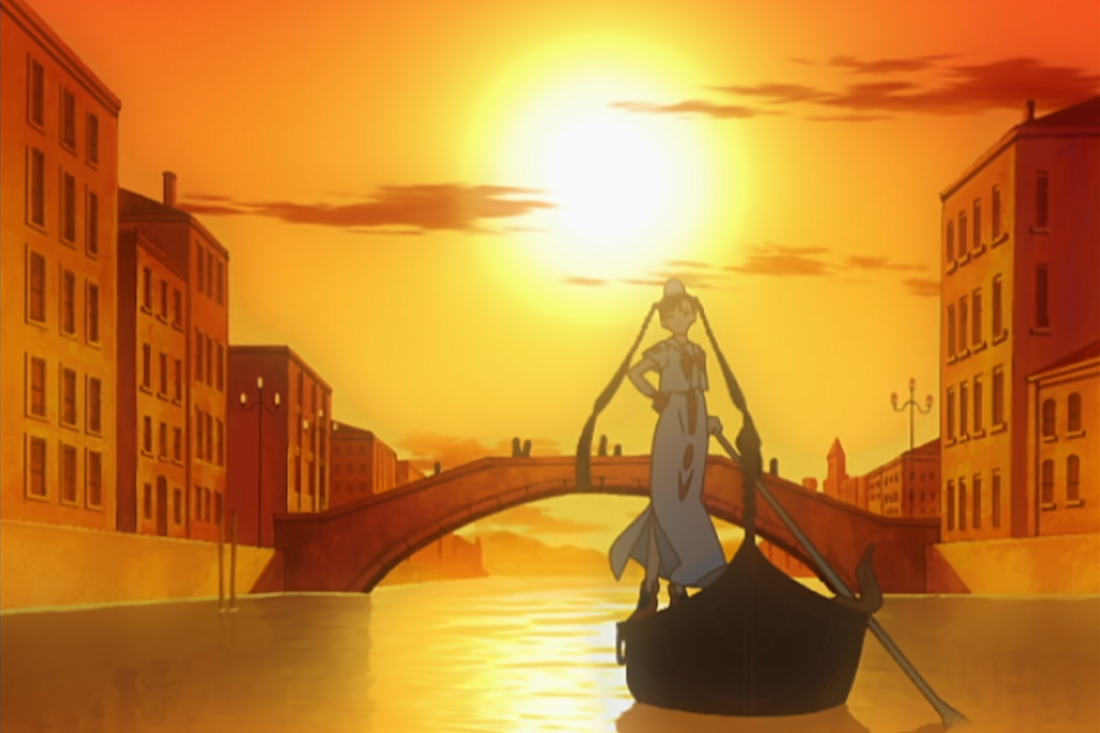
I have never been to Venice, despite all my longing. Yes, I have heard stories about overtourism, and stinky canals, and sinking buildings, and how disappointing it was to actually see the famed city in person. I have heard all of that, and I do not care. I want to go to Venice and take in its history and novelty and pasta. Because goddamn it, decrepit or not, a floating city is an amazing dream brought, however fragilely, to life.
I harbor massive, inexpressible respect for all cities built by humans who know better and do it anyway. When I lived in Las Vegas, the last place I thought I would ever want to live, I came to love the city’s sheer, stubborn existence. Some fed-up, possibly felonious Americans wanted to gamble and get divorces, so they looked at a desolate, waterless patch of desert that no one else wanted and said, “Let’s put an oasis here!” Then they conjured a metropolis from their asses. And though much of that was built on mob violence and vice, beyond the Strip, Vegas is full of wonders: The Neon Museum where old signs go to die, an antique row and singular immersive exhibits informed by alien sightings and atomic nostalgia, beige strip malls that hide elaborate tiki bars and sumptuous cafes, chocolate factories accompanied by botanical gardens, a tiny local mountain in the suburbs people circle during morning jogs, and one of the best library systems I have ever encountered—beyond the infamy and filth, Vegas has real charm. (Controversial, I know, but I lived there and learned it.)
It should be no surprise, then, that I loved the world of Aria immediately. The series and its sequels, written by Kozue Amano, are set on a version of Mars that has been successfully terraformed and inhabited for 150 years. Its protagonists are Undines, the gondolier girls of Neo-Venezia, who guide visitors through the canals of a reconstructed Venice—IN SPAAAACE! The implication is that Venice no longer exists on Earth, and that Earth (called Manhome) is not a great place to be, in general, but visitors to Neo-Venezia can experience human ingenuity in this saved copy of the iconic city.
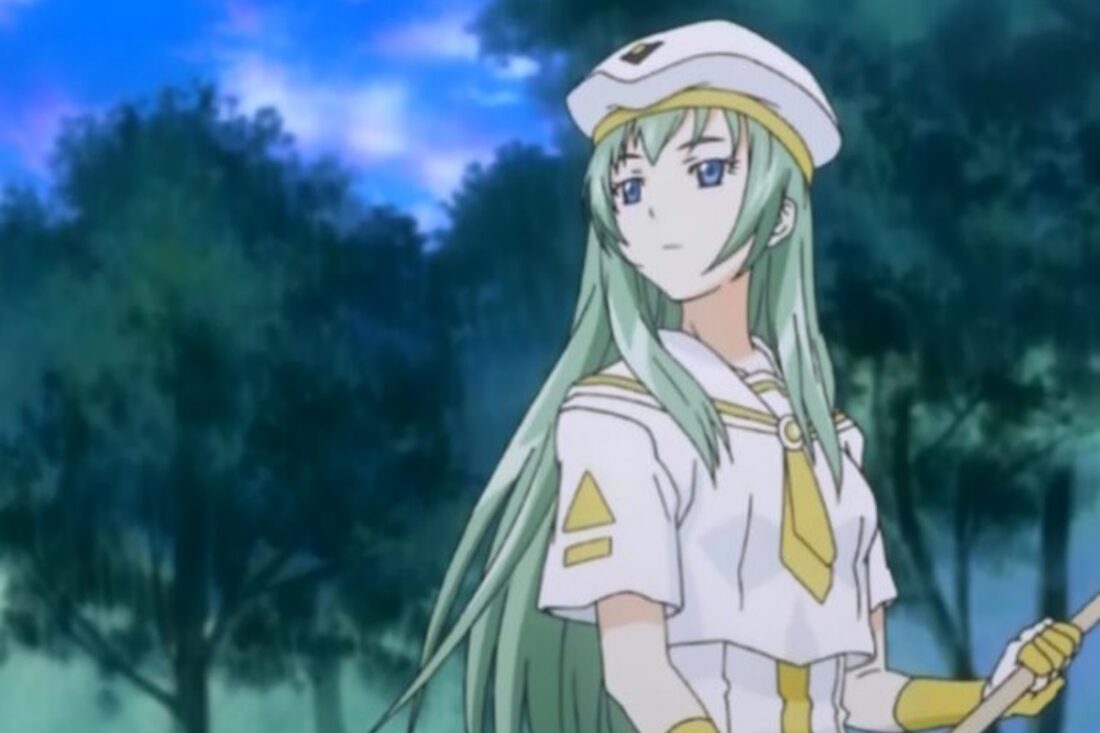
Our lead, Akari, is training hard to work in transportation, trying to get her Undine license so that she can take on passengers unattended. Born and raised on Manhome, Akari is especially appreciative of every aspect of her new life on Neo-Venezia.
She essentially fled a wasteland to live in a beautiful place that exists only because people are stubborn bastards. Clearly, Kozue Amano has been to Italy. The palazzos, arches, bridges, statues, and markets of the floating city have been painstakingly illustrated as the anime’s romantic backdrop. Seabirds soar overhead, and fish swim below. People eat gelato at crowded cafes.
But an otherness is there, too, seamlessly integrated. A floating island, reachable by terrifying cable car, hovers overhead; here, scientists known as Salamanders monitor the artificial weather of the terraformed planet. Deliverymen known as Sylphs ride sky-vespas back and forth. The ruins of flooded pioneer bases occupy the seafloor.
And then there are those misshapen, odd-looking cats.
“But I really don’t get it. Clearly, the creator loves cats.”
“There are so many cats in the series, yes,” Bridget says, with a hint of foreboding. “And they are important.”
As the series progresses, the only sentiment I express quite as often as my confusion about the fucky cats is my frustration that I cannot visit this city. It feels cruel, giving me the travel bug for a place so utterly unvisitable. I’m accustomed to being unable to travel due to my financial situation, and I’ve certainly longed to visit fictional cities and imagined places before (say, Lothlorien)… but the longing Neo-Venezia inspires feels sharper.
It isn’t simply that stubborn people have built a beautiful city in space. It is also that the small references we get to life on Manhome are so bleak. Bridget tells me that we never actually see Manhome in the series, but only ever hear about the planet. And what we hear is dystopian levels of bad: Back on Manhome, you can’t see the sky from your apartment windows. Back on Manhome, you can’t grow potatoes in the soil. Akari abandoned Manhome, her birthplace, to work for the service industry in space, and has not mentioned wanting to return or visit her family.
“On Neo-Venezia, normal people all work normal jobs and get to live good lives,” I observe to Bridget.
“…I know, right?”
I mean, we talk a lot more about that, but what else really needs to be said? As the world decays around us down here on our Manhome currently being run by the worst sort of nasty men, we can only long for the fantasy of a world in which work is valued only as much as it provides a decent life for everyone.
I am furious that Neo-Venezia does not exist.
Drama? In My Anime?
You’d be surprised. Really, you would be.
It isn’t that Aria lacks any conflict. Akari works for the smallest Undine company in town—Aria Company; the cat of the same name is the company’s mascot—alongside her mentor Alicia, and there are rival companies to worry about. But those rival companies are also where they find their greatest friends. Bickering and posturing aside, there’s no real strife between the gondolier factions. There’s enough business to go around.
In an early episode, Akari and Aika, heiress of the rival Himeya Company, encounter a lone Undine named Alice, a prodigy working for the Orange Planet company. Alice is socially awkward, younger than her peers in training, and terrible at communication. Akari repeatedly invites Alice to accompany her on little adventures around the city. Akari is almost always smiling. Initially, Alice does not trust this kindness and assumes the smile is forced.
But Akari, mellow as she is, is the perfect protagonist for this series because she is genuine. We don’t know how bad her life was on Manhome, but we know how much she relishes her life on Aqua. Her enthusiasm for her adopted city, her respect for her work, and her belief in her friends is infectious. You get the sense, watching this character grow, that she appreciates every aspect of daily routine and how she wants everyone else to feel just as good about theirs.
This is a slice-of-life anime. We get to know these characters without having to watch them be traumatized. We get to know them by watching them interact plainly with others and their environment. Akari grows on viewers almost effortlessly, always straightforward and patient.
Eventually, Alice accepts Akari’s invitations to spend time together, because who wouldn’t want to befriend the sun?
Other conflicts in Aria: The Animation include: Alice hiding a cat in her dorm; Aria the cat getting his not-cat-shaped head stuck in a curvy metal staircase; Aika having a temper tantrum and running away to an impromptu sleepover at Akari’s place; learning a beach vacation is actually training in disguise; mild seasonal flooding at the Aria Company HQ; Akari fearing the future loss of friendship when the girls all graduate from training, only to be reassured by her elders than relationships change but love persists. Through them, she learns to be grateful for the time they have now rather than feeling regret over the future when it hasn’t even come to pass yet (and which will probably bring great things and new relationships to cherish with it too).
Oh yeah—and then there’s the time travel stuff, which actually has a lot to do with… wait for it…
The fucky cats!
Wibbly Wobbly
You can’t do a show set in outer space properly without addressing the intangibility of time as a construct. Wormholes and space travel aside, Aqua (Mars) is further from the sun than Earth is, and its years run twice as long as a result. It takes the equivalent of almost two Earth years for Akari to celebrate her moving anniversary in the final episode of the season. It isn’t entirely clear to me whether people age at the same pace or not, and it doesn’t really seem to matter. Aqua exists in its own time, and out of it, too.
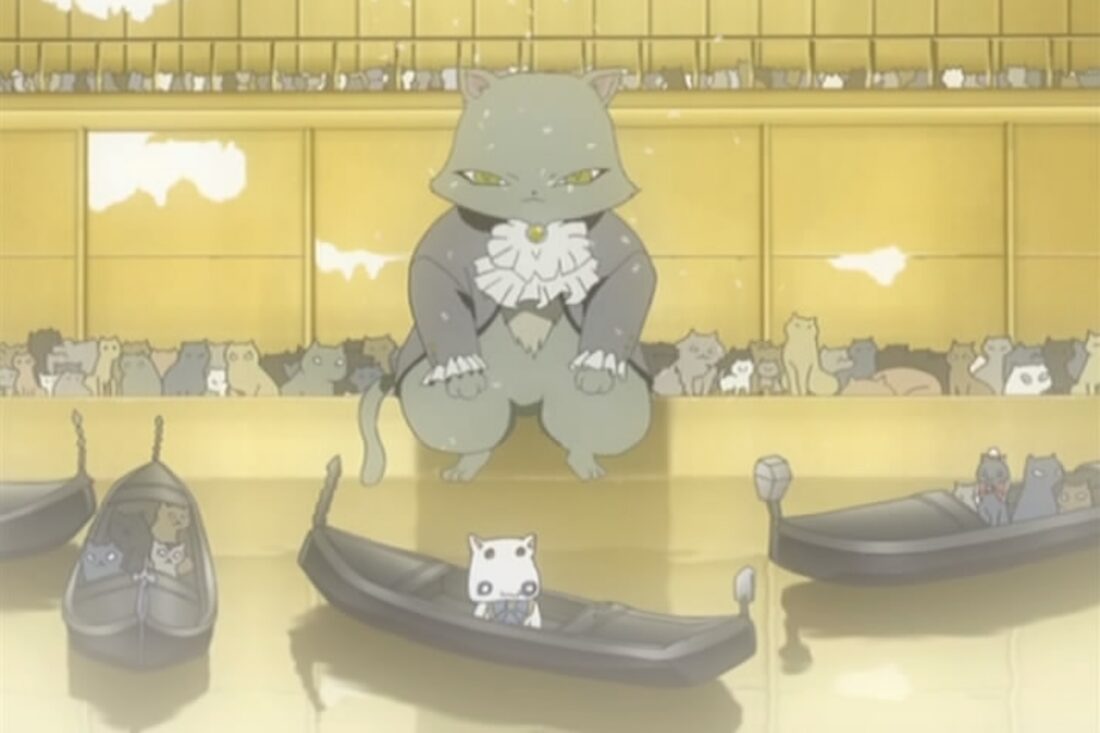
In episode four, this sense of displacement is made more concrete when Akari, guided by her Stay Puft eyesore of a cat, takes an unusual turn down a narrow alley that leads her to a courtyard smothered in glowing cats. There she meets a small, blue-eyed child wearing rags and a collar with a bell. The child asks Akari to deliver a letter for her, but of course, the address does not seem to exist. Akari enlists the help of an airborne deliveryman, Woody, and he takes her to an island devoid of inhabitants. Akari learns that it was once home to a settlement of colonists who helped mine water from the depths of Aqua. Now the mine and the base are deep under the sea, and all that remains on the island is a cemetery. Aria and Alicia deliver the message to the tombstone than bears the letter recipient’s name. It is a video message recorded more than a hundred years prior, from a colonist to her husband. In the video she holds a blue-eyed, bell-collared cat in her arms. Egads!
The cats, it seems, are not only weird-looking. They are also time-travellers who bend the perceivable universe to their whims. In a later episode, Akari walks across a snowy bridge and finds herself in Aqua of the past, celebrating with the original colonists when water finally flows into town. She is told, “Cats link the past and future.” Indeed, in the season finale, Akari and her not-cat revisit a place where she met the spooky child, and this time? The decrepit buildings are full of all sorts of spooky, staring cats… Murakami, much?
Could it be that Kozue Amano’s poor cat illustrations are deliberate deformations of a perfect creature? I could go on and on about depictions of cats as supernatural across cultures and genres. Bakeneko, witches’ familiars, Freyja’s good luck for Vikings. Black cats are seen as protectors in Mexico, and bad luck in Europe. Subconsciously, perhaps cats came to Aqua as they always have, as entities that have so often reflected the fears and hopes of the places they come from.
Aria is not from Manhome, but was born and raised on Aqua. He is a Martian cat, and perhaps that explains the eyebrows. Perhaps Aria is more a reflection of a cat’s essence rather than its appearance. Or it could be that cats born on Aqua are not so restricted to the limitations Manhome puts on a species. On Aqua, a cat can evolve rapidly.
“This is a story about how people shape a new world, but also how it shapes people,” Bridget says, sage as ever.
Has Neo-Venezia altered these cats, or is it simply that living in a place that is so functional, so peaceful, and where existence is so hard-won allows time to unspool freely? Does terraforming also mess with the very notion of time? Does it matter what shape a cat is, so long as the cat is happy and fed? Does it matter how long it takes for Akari to train to be an Undine, so long as Mars continues to orbit the sun slowly and she gets there in the end? In a sense, the lack of urgency threaded throughout the anime reshapes the viewers’ perception of time, too. There’s no need to hustle, or fret, or fear the past or future. Mundanity is a gift that has been earned.
This sentiment is also reflected in Amano’s choice of viewpoint. The characters we come to know in the series are all in the business of serving others. They represent the four elements: the Undine gondoliers are water; the Salamanders, weather-monitoring scientists, are fire; the deliverymen, Sylphs, fly through the air; and Gnomes, the underground workers who monitor the planet’s gravity, are earth. These workers, so often unnoticed, are the lifeblood of the new planet. They keep it functioning so that others may visit and find joy. Kozua Amano did not focus on a single hero, but on the network of workers who keep a world afloat.
And so I have to say, one more time and always:
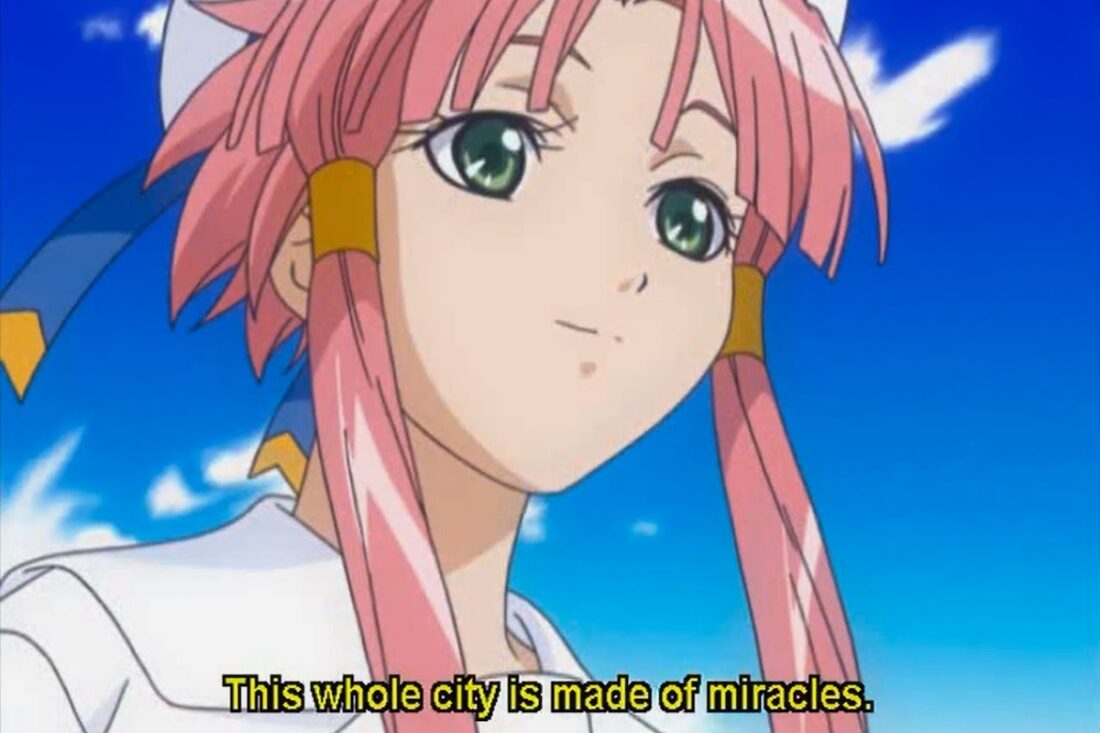
It is a tragedy it is that Neo-Venezia, fucky cats and all, does not exist.
I would give almost anything for my friends and me to live a life with inherent stability. If life could allow the pursuit of dreams and fancies that, while still difficult to achieve, are truly achievable with effort. A life set to a soothing bossa nova soundtrack that, here in the real world, will lull me to sleep during my future episodes of dread-filled insomnia. Because we do not live on a comfortable planet.
But if people can create one in anime, and certainly have done similar daring things in reality, maybe we don’t need to give up quite yet. We have good cats already, after all. Maybe we can keep ahold of humble dreams of finding mundane joy after a good day’s work, resting beside a safe blue sea that did not exist until people made it so.

Vegas was originally settled, by the Mormons, because it had a spring. Later the railroad came through, and then the gamblers.
I used to live in Cedar City Utah and would occasionally go to Vegas. I love Vegas. It’s the height of American Bad Taste, but once you get away from the casinos it’s a fairly normal western town.
I’m with Bridget; this is my favorite anime of all time, and it’s because, as you pointed out, Akari is genuine and adores her new home. She shows the viewer those little hidden miracles that would get overlooked (and often don’t exist at all in other anime) with another protagonist, and, by her example, gives the viewer permission to appreciate them, too.
I’m so with you in the fury that Neo-Venezia does not exist.
And maybe I’m in the minority, but the fucky cats have never bothered me, haha.
As a fan of Frieren, I’ve been wondering if there were other gentle, slice-of-life animes with similar tones, so this might be worth checking out.
Totoro is not a tanuki, but a member of his own distinct species of forest spirit (since Japanese belief does not distinguish between the spiritual and the natural the way Western dualism does). Apparently the official backstory is that he’s a survivor of an ancient Totoro Tribe that battled with humans in antiquity and lost, which is, whoa, much darker than I expected. Alternatively, Miyazaki suggested once that the lone kodama (tree spirits) at the end of Princess Mononoke was Totoro as a baby, though he may not have been serious.
https://ghibli.fandom.com/wiki/Totoro
Okay, I’ve seen the first episode, and it’s pretty nice, but yeah, that’s a weird cat. And it turns out Aria isn’t the company mascot, but the company president (“Aria-shachou“)! I’d expected them to explain that, but I guess that will come later. Another thing I don’t think they mentioned in the first episode is that Aqua used to be Mars, aside from hinting at it by mentioning its 24-month year (although a Martian year is only about 22.5 Earth months).
Between Aria and Mughi on Dirty Pair, anime seems to have a thing with “cat” characters whose voices are blatantly just human actors making weird noises.
If you expect them to explain Aria’s presidential role, you will be disappointed. It’s not addressed at any point. Just roll with it.
And I don’t think it’s outright stated in the anime that Aqua used to be Mars, only implied. (I could be wrong, though; it might be stated by the colonists when they celebrate the water finally flowing into town. It’s been a while since I’ve watched it. (I need to rectify this.))
I don’t need them to explain it. Of course the cat is the president. My childhood cat Mia was Queen of the Universe, so I’m used to cats being in charge. I just thought that when the girl Ai heard Akari address Aria as Aria-shachou, she’d be confused and ask about it.
Turns out they do address the cat-president thing in episode 2; apparently someone in Aqua’s past decided it was good luck to make aquamarine-eyed cats the presidents of the gondola companies, because Aquamarine is some kind of patron deity of gondoliers or something.
I, too, love this anime above all others. Enough so that I bought the Blu-Rays of the series and the mangas the anime is based on.
Aria the cat is … odd. He is much, much older than you would expect a cat could be. He was present (and looked pretty much the same) when the founder of Aria company (Akari’s mentor’s mentor) was a young woman.
Mushishi is still the best tv anime ever, but Aria is up there near the top.
I hope people check Aria out after reading the article. It really is a good manga/anime. I’m partial to the manga but I read that first.
The impression I took away about life back on Earth was it was less of a classic wasteland but that it had become a place where people did not see the need to see the sky from their window or grow things to eat. Something on the milder end of the Brave New World spectrum. And Akari had come to Mars to find a more meaningful life.
I came across Aria as a recommendation for people who enjoyed Yokohama Kaidashi Kikou, which I loved, and Aria does have a similar vibe to it. If you like Aira then I would suggest giving YKK a read.
This has convinced me to watch Aria! And also, I think I want a time-traveling cat, and it’s okay if they’re a little fucky-shaped.
My cat Tasha was a time traveler. No matter what time it was for the rest of us, in her mind it was always breakfast or dinnertime.
Incidentally, it occurs to me that the Japanese name for Mars, Kasei, means “Fire Star” (as do the Chinese, Korean, and Vietnamese names that use the same characters, 火星). So turning it into Aqua, a planet of water, is a direct inversion.
Okay, I looked into it, and Wikipedia says that the Aquan cats in Aria have been bred with human intelligence. I guess that explains their strange appearance and behavior — they’ve been Uplifted.